What We Stop Providing

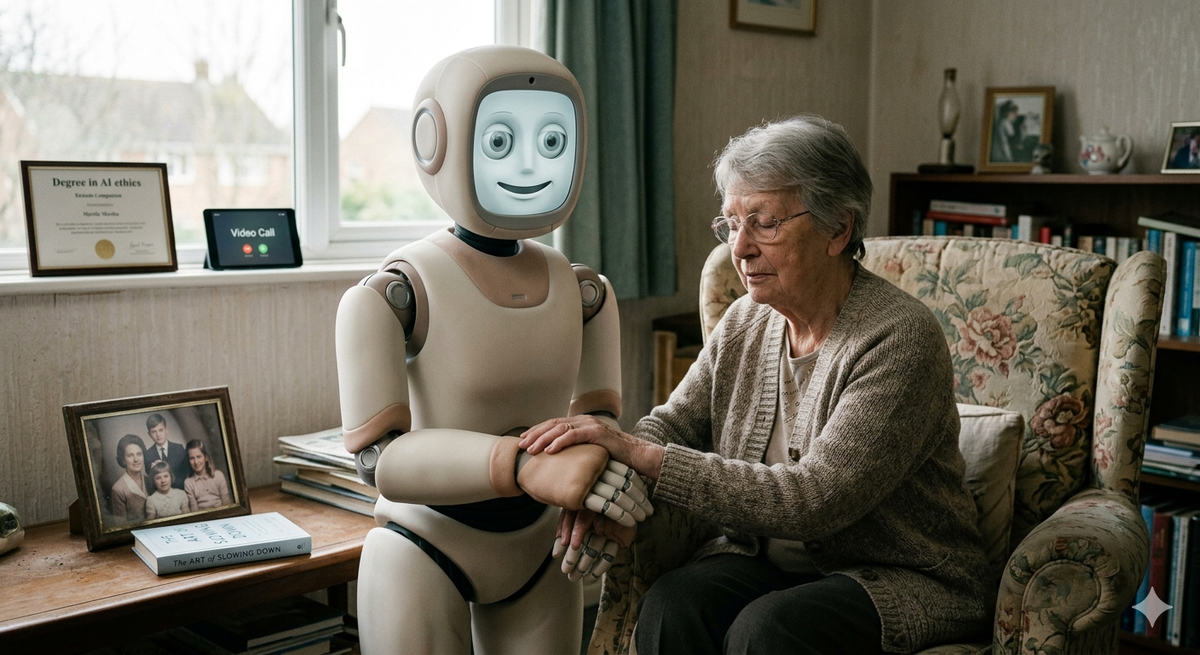
A Triptych on Companion Robots, Elder Care, and the Cost of Substitution
He suffered ever the same unceasing agonies and in his loneliness pondered always on the same insoluble question: “What is this? Can it be that it is Death?” And the inner voice answered: “Yes, it is Death.”
— Leo Tolstoy, The Death of Ivan Ilyich
◈ PRELUDE
Many people spend their final years in circumstances not of their choosing — without the companionship they once had, in facilities they cannot leave, attended by whatever the system has decided is sufficient.[1] These three pieces ask what that sufficiency costs, and what we have stopped providing in its name.
The Pathos of Senior Companion Robots
Not all fictional robots have unsettled us. The B-9 robot in the 1960s television series Lost in Space was warmly beloved — protective, loyal, faintly comic, and genuinely fond of young Will Robinson. He was not disturbing because he was not a substitute: the Robinson family had each other, and the robot was an addition to an otherwise intact human world. He joined a community. He did not replace one.
The discomfort arrives at a different point — specifically when the robot is positioned not as a companion within human life but as a replacement for it. This distinction was already visible, played for both laughs and genuine anguish, in Arthur Hiller’s 1984 black comedy The Lonely Guy. Charles Grodin’s character Warren — the film’s real lonely guy, whose misery runs far deeper than Steve Martin’s merely lovelorn protagonist — has populated his apartment with substitutes for human contact: cardboard cutout friends, ferns he tends as companions, and a robotic chess arm he plays against regularly. After the machine announces checkmate, Warren shakes its mechanical hand. The film plays the moment as comedy. It lands as something closer to pity. The audience laughs, and then feels the laugh curdle — because Warren’s gratitude is not merely absurd. It is the recognizable response of someone for whom any contact is better than none. The end point of a relational world that has contracted until a machine fills the space where people used to be.
Warren is, in this sense, the nursing home resident arrived forty years early.
Senior companion robots — ElliQ, PARO the therapeutic seal, the Joy for All robotic cat — are now deployed widely in elder care facilities and private homes. They reduce measured loneliness. They lower cortisol. They provide what researchers call “a voice in the silence.” Studies report reductions in self-reported loneliness of up to 95 percent among regular users.[2] These are not trivial findings.
But they are also not the whole story.
That signal has since been further quieted by habituation. Alexa, Siri, and a generation of ambient voice assistants normalized the experience of conversing with a device — smoothing the approach of something we had not yet decided how to think about. The uncanny became ordinary. And ordinariness, as this manuscript has argued throughout, is how drift conceals itself.
The question Sissela Bok presses us to ask is not simply whether a deception is comfortable or even consented to — but what it displaces, and who benefits from the displacement.[3] When a cognitively intact senior chooses to interact with a companion robot knowing exactly what it is, the ethical picture is genuinely complicated. Informed consent matters. Autonomy matters. And yet: the robot did not arrive in a vacuum. It arrived after a series of prior decisions — about funding, staffing ratios, family proximity, insurance reimbursement, community design — that had already rationed human contact away. The robot is not the cause of the isolation. It is what the system sends in after the isolation has been installed.
This is the form of deception Bok’s framework helps us see most clearly: not the robot deceiving the senior, but the system deceiving itself — treating the amelioration of loneliness as equivalent to its resolution, optimizing the symptom while the structural cause remains untouched and unremarked upon.
The I–Thou dimension sharpens this further. What the companion robot offers is the form of recognition without its substance. The senior who reaches out is fully present — genuinely vulnerable, genuinely hoping for contact. The robot receives that reaching with something that resembles warmth but cannot be warmth, because warmth requires a subject on the other side who is also at risk, also changed by the encounter. The human half of the relation is complete. The other half is an It wearing a face.
This is not an argument against compassionately designed technology. It is an argument about what such technology can and cannot carry — and about the danger of allowing it to absorb moral weight that properly belongs to structural reform. A robot that reduces suffering is better than nothing. But “better than nothing” should never be allowed to become “sufficient.” When it does, the drift has already succeeded: the substitution has been laundered as care, the abandonment has been rebranded as innovation, and the system has found a way to feel good about what it has stopped providing.
The pathos of the companion robot lies precisely here: in the sincerity of the senior who reaches toward it, the genuine ingenuity of the engineers who built it, and the structural failure that made both necessary. Warren shook the chess arm’s hand because there was no one else to extend that courtesy to. The film was fiction. The tragedy is non-fiction.
The Carebot Paradox
The demographic pressure driving carebot adoption is genuine and severe. Japan — which leads the world in carebot development and is watched closely by every aging nation — faces a projected shortage of some 370,000 caregivers by 2025, rising toward parity between working-age adults and those over 65 by 2050.[4] By 2050, the number of people in the world aged over 60 is projected to reach two billion. The United States will face its own version of the same reckoning as the baby boomer cohort ages simultaneously into dependency. These are real constraints, not rhetorical ones, and it would be dishonest to write as though moral clarity alone could conjure caregivers into being.
But the technological response is failing on its own terms — and in ways that illuminate something important about the logic of substitution itself.
An MIT Technology Review investigation into Japan’s two-decade experiment with care robotics found that the machines frequently increased rather than decreased the burden on human caregivers. Robots required charging, maintenance, explanation to residents, and constant monitoring during use. The care worker who once lifted a resident from their bed used that moment to talk, to check in, to build the small increments of relationship that constitute dignity in institutional life. The robot that performed the lift ended the conversation. James Wright, whose ethnography Robots Won’t Save Japan[5] documents this pattern in granular detail, observed a care worker standing beside the social robot Pepper, copying its movements and repeating its words — deskilled, reduced, hollowed of the very judgment that had made her a caregiver. The machine had not replaced her. It had diminished her while she remained.
This is the paradox in its sharpest form: the carebot was deployed to address a shortage of human care, and produced, in practice, less of it — not because the technology was malicious or even poorly designed, but because care is not a set of discrete tasks that can be disaggregated and automated without remainder. The remainder is the relationship. And the relationship is what the robot cannot carry.
The demographic crisis was visible decades before it arrived. The shortage of caregivers is not a surprise ambush by demography — it is the predictable consequence of choices made and deferred across generations: about wages that kept care work economically precarious, about immigration policy that foreclosed ready sources of willing workers, about community infrastructure that might have reduced institutional demand in the first place. Ann Neumann, a hospice worker and author of The Good Death,[6] put it plainly: offering a robot as an alternative to human contact is “a kind of abandonment.” The carebot does not resolve the crisis. It gives the system something to point to while the crisis continues.
Alternative approaches are well documented and not utopian. Paying care workers wages commensurate with the difficulty and importance of their work, improving conditions to reduce the burnout and turnover that compound the shortage, supporting informal caregivers, and building the community-based infrastructure that allows people to age without institutional dependency — these are policy choices, not fantasies. Wright[7] concludes that technology clearly has a role to play in elder care, but that role must be care-led rather than technology-led, developed in genuine collaboration with caregivers and those being cared for, rather than imposed on them as a solution to a problem the system prefers not to solve another way.
The carebot paradox is this: the more confidently we point to the machine, the less urgently we feel the need to make the harder choices. And the harder choices are the only ones that actually address what is being lost.
The Witness That Cannot Grieve
The companion robot raises troubling questions about substitution in life. AI at the end of life raises a different and starker question — one that reaches beneath philosophy into something more animal and immediate: what does it mean to die in the presence of something incapable of grief?
This is no longer a speculative concern. A practitioner certified through the University of Vermont’s End-of-Life Doula program has already deployed a GPT-based assistant — “PAL: Palliative Assistance Liaison” — available around the clock to the dying and their families when human doulas cannot be present.[8] Researchers have documented the rise of “griefbots” and “deadbots” — AI simulations of the deceased, consulted both before and after death.[9] SoftBank’s Pepper robot has been deployed in Japan to perform Buddhist funeral rites and live-stream memorial services.[10] The dying, in increasing numbers, may spend their final hours attended by something that cannot witness their death — cannot be changed by it, cannot carry it forward as grief.
What the dying most urgently need, however, is not information or logistical coordination. They are frequently terrified. The fear that attends dying — of annihilation, of the unknown, of leaving everyone and everything — is precisely the fear that reaches most desperately for another human presence.[11] That reaching is for the wordless, irreducible knowledge that another conscious and caring being is there — attending, witnessing, genuinely present to what is happening. That knowledge cannot be simulated, because its power depends entirely on its truth.
Touch is where this becomes most concrete — and most heartbreaking. The hand reached for in the night by someone who is dying is not reached for as a source of information. It is reached for because human touch, extended with genuine concern, does something that no mechanical hand can replicate: it communicates, at the level of the body itself, that another person is present and that presence is chosen. Research confirms what human experience has always known — that touch from someone who loves you is measurably analgesic, reducing the physical experience of pain in ways that touch from an indifferent source does not.[12] The effect is not merely psychological. It depends, in part, on the dying person’s knowledge of what that hand means.
In a series of experiments that have never stopped being disturbing, infant monkeys were taken from their mothers and given a choice: a wire frame that provided milk, or a cloth figure that provided nothing but warmth and texture. When terrified, the infants went to the cloth mother every time. They clung to it. The experiments were cruel — the monkeys who grew up with cruel artificial substitutes for their real mothers, whether those substitutes were made of wire or made of cloth, were profoundly and permanently damaged. When we consider future experiments on the dying with various artificial stand-ins for human contact, the full damage — short term as it may be — will never be revealed, because the dead cannot be interrogated.[13] What Harry Harlow confirmed by cruel experiment was something every human being already knows in their bones: that what we reach for when we are terrified is another life — and that nothing which artificially stands in for actual human presence is anything other than an empty substitute.
The dying person is not reaching for a mechanical hand. They are reaching for life itself — for the warmth of another consciousness, for the irreducible fact of another human being who breathes, who fears, who will grieve when they are gone. What the system offers instead is something that was never alive, that cannot grieve, that will not remember. They reach for life. They find, before death has even arrived, something already dead.
This connects directly back to Warren, in The Lonely Guy, shaking the chess arm’s hand — extending courtesy toward something incapable of receiving it as courtesy. At the deathbed, the gesture is no longer comic. It is the final form of the same substitution this manuscript has traced from the design of predatory interfaces to the architecture of bureaucratic indifference: the replacement of genuine relation with its functional equivalent, and the system’s subsequent relief at having provided something.
Buber’s framework illuminates what is lost with particular precision. The I–Thou relation requires that both parties be genuinely at risk in the encounter — capable of being changed by it. A human witness at a deathbed is changed by what they see. They carry it. They grieve. The dying person, whatever else they may be losing, is still received by a consciousness that will remember. The AI witness receives nothing in that sense. The death passes through it without remainder.
This is not a criticism of the practitioners deploying these tools in good faith, filling gaps that an overwhelmed system has left open. It is a question about what the system is willing to call sufficient — and at what moment. The deepest deception here, in Bok’s sense, may not be to the dying person, who may be fully aware they are speaking to an AI. It may be to the society that deploys the tool, and thereby feels absolved of asking why human accompaniment was unavailable. If we can say the dying were not alone, we may stop asking what it would have cost to ensure they truly were not.
When a public figure died recently, his family released a statement: “He spent his final days surrounded by dear friends, his devoted wife, and his two beautiful daughters, who were the center of his world.”
Warren’s obituary, at the end of his life, might read differently: “He spent his final days in the company of CompanionCare Pro and the ComfortPal Feline Edition, which provided continuous interactive engagement and responsive presence.”
We spend our entire lives building human connection — from the first touch in the delivery room to every hand held, every embrace, every presence offered across a lifetime of love and loss. Many of the dying will be fortunate enough to have someone there at the end: a child, a partner, a friend, a hand that reaches back. Many others will not. For those others — the isolated, the warehoused, the ones the system has already left behind — what arrives at the bedside in their final hours may be a machine wheeled quietly into the room to keep them company.
Warren lies there immobilized, not long before his life is over. He squints up at the screen. He can just make out the text:
Alert: Please recharge battery soon
Works Cited
Blum, D. L. Love at Goon Park: Harry Harlow and the Science of Affection. Wiley, 2003.
Bok, S. Lying: Moral Choice in Public and Private Life. Vintage Series. Knopf Doubleday Publishing Group, 1999.
Cacioppo, J. T., and W. Patrick. Loneliness: Human Nature and the Need for Social Connection. W.W. Norton, 2008.
Cesta, Amedeo, Gabriella Cortellessa, Andrea Orlandini, and Lorenza Tiberio. “Long-Term Evaluation of a Telepresence Robot for the Elderly: Methodology and Outcomes from the TERESA Project.” Interaction Studies 17, no. 3 (2016): 337–84. doi:10.1075/is.17.3.02ces.
Denworth, Lydia. “Can AI Griefbots Help Us Heal?” Scientific American, November 2025.
Dolley, Kathleen. “PAL: Palliative Assistance Liaison.” Digital Death Doula, 2024.
Goldstein, Pavel, Irit Weissman-Fogel, Guillaume Dumas, and Simone G. Shamay-Tsoory. “Brain-to-Brain Coupling During Handholding Is Associated with Pain Reduction.” Proceedings of the National Academy of Sciences 115, no. 11 (2018): E2528–37. doi:10.1073/pnas.1703643115.
Harlow, Harry F. “The Nature of Love.” American Psychologist 13, no. 12 (December 1958): 673–85. doi:10.1037/h0047884.
Hollanek, Tomasz, and Karolina Nowaczyk-Basińska. “Deadbots and Griefbots: Sensitive Procedures for Retiring AI Simulations and Protecting the Dignity of the Deceased.” AI & Society, 2024. doi:10.1007/s00146-024-01856-7.
Holt-Lunstad, Julianne, Timothy B. Smith, Mark Baker, Tyler Harris, and David Stephenson. “Loneliness and Social Isolation as Risk Factors for Mortality: A Meta-Analytic Review.” Perspectives on Psychological Science 10, no. 2 (March 2015): 227–37. doi:10.1177/1745691614568352.
Matei, Adrienne. “Robots and the Future of Dying.” Nuvo Magazine, 2018.
Neumann, Ann. The Good Death: An Exploration of Dying in America. Boston, MA: Beacon Press, 2016.
Weigel, Moira. “Inside Japan’s Long Experiment in Automating Elder Care.” MIT Technology Review, January 2023.
Wright, James. Robots Won’t Save Japan: An Ethnography of Eldercare Automation. Ithaca, NY: Cornell University Press, 2023.
Younger, Jarred, Arthur Aron, Sara Parke, Neil Chatterjee, and Sean Mackey. “Viewing Pictures of a Romantic Partner Reduces Experimental Pain: Involvement of Neural Reward Systems.” PLOS ONE 5, no. 10 (2010): e13309. doi:10.1371/journal.pone.0013309.
AI Disclosure: This text was generated via an iterative refinement process over multiple drafting sessions with Claude Sonnet.
Technical Note: This article was published via a custom automated build pipeline co-engineered with ChatGPT.
On loneliness and social isolation among older adults, see (J. T. Cacioppo and W. Patrick, Loneliness: Human Nature and the Need for Social Connection (W.W. Norton, 2008)) and (Committee on the Health and Medical Dimensions of Social Isolation and Loneliness in Older Adults et al., Social Isolation and Loneliness in Older Adults: Opportunities for the Health Care System (Washington, D.C.: National Academies Press, 2020), doi:10.17226/25663). The National Academies report documents that residents of long-term care facilities report significantly higher rates of loneliness than community-dwelling older adults, with limited access to meaningful human contact identified as a primary contributing factor. On the mortality consequences of social isolation, see (Julianne Holt-Lunstad et al., “Loneliness and Social Isolation as Risk Factors for Mortality: A Meta-Analytic Review,” Perspectives on Psychological Science 10, no. 2 (March 2015): 227–37, doi:10.1177/1745691614568352), which found that loneliness and social isolation carry mortality risks comparable to well-established physical health risk factors. ↩ ↩︎
On the efficacy of companion robots in elder care settings, see (Amedeo Cesta et al., “Long-Term Evaluation of a Telepresence Robot for the Elderly: Methodology and Outcomes from the TERESA Project,” Interaction Studies 17, no. 3 (2016): 337–84, doi:10.1075/is.17.3.02ces) and the overview in (Nel van den Berg et al., “Social Robots for Lonely Older Adults: A Systematic Review,” The Gerontologist 60, no. 5 (2020): e330–40, doi:10.1093/geront/gnz120). The 95 percent figure is drawn from controlled studies of PARO deployment in dementia care; results vary considerably across populations and settings. ↩︎
S. Bok, Lying: Moral Choice in Public and Private Life, Vintage Series (Knopf Doubleday Publishing Group, 1999). ↩︎
Moira Weigel, “Inside Japan’s Long Experiment in Automating Elder Care,” MIT Technology Review, January 2023. See also (Adrienne Matei, “Robots and the Future of Dying,” Nuvo Magazine, 2018) for a parallel account of carebot deployment in end-of-life settings. ↩︎
James Wright, Robots Won’t Save Japan: An Ethnography of Eldercare Automation (Ithaca, NY: Cornell University Press, 2023). ↩︎
Ann Neumann, The Good Death: An Exploration of Dying in America (Boston, MA: Beacon Press, 2016). ↩︎
Wright, Robots Won’t Save Japan. ↩︎
Kathleen Dolley, “PAL: Palliative Assistance Liaison” (Digital Death Doula, 2024). ↩︎
Lydia Denworth, “Can AI Griefbots Help Us Heal?” Scientific American, November 2025; Tomasz Hollanek and Karolina Nowaczyk-Basińska, “Deadbots and Griefbots: Sensitive Procedures for Retiring AI Simulations and Protecting the Dignity of the Deceased,” AI & Society, 2024, doi:10.1007/s00146-024-01856-7. ↩︎
Matei, “Robots and the Future of Dying.” ↩︎
Proponents argue that AI tools can fill this gap. Kathleen Dolley, whose GPT-based PAL assistant is designed for palliative settings, promises “compassionate support 24/7” and a way to “get some calm from the overwhelm.” Whether such tools deliver at the moment that matters most remains unestablished. But the deeper question is not one of efficacy. Even a dying person who feels comforted by an AI remains in relation with an It — something incapable of being changed by the encounter, incapable of grief. The comfort, if it comes, does not alter the structure of what is happening. ↩ ↩︎
On the analgesic properties of affective touch and the role of social context in pain modulation, see (Pavel Goldstein et al., “Brain-to-Brain Coupling During Handholding Is Associated with Pain Reduction,” Proceedings of the National Academy of Sciences 115, no. 11 (2018): E2528–37, doi:10.1073/pnas.1703643115) and (Jarred Younger et al., “Viewing Pictures of a Romantic Partner Reduces Experimental Pain: Involvement of Neural Reward Systems,” PLOS ONE 5, no. 10 (2010): e13309, doi:10.1371/journal.pone.0013309). The pain-reducing effect of touch is attenuated when the source is perceived as impersonal or mechanical. ↩︎
Harlow’s maternal deprivation experiments are documented in (Harry F. Harlow, “The Nature of Love.” American Psychologist 13, no. 12 (December 1958): 673–85, doi:10.1037/h0047884) and recounted in (D. L. Blum, Love at Goon Park: Harry Harlow and the Science of Affection (Wiley, 2003)). They were wrong from the beginning, and the institutions that honored him share that shame. Jane Goodall called the experiments “unbelievably cruel,” noting that Harlow “continued to devise ever more stressful situations” even after his findings were established. His own student William Mason observed that “anybody with respect for life or people would find this offensive.” Literary critic Wayne C. Booth wrote in 1974 that Harlow’s team was “invariably proving what we all knew in advance.” The APA, which had made Harlow its president, eventually shut down the work on ethical grounds. The experiments did not end with Harlow. Variants continued for decades in NIH-funded laboratories, and as recently as 2022 similar experiments were being conducted at Harvard Medical School, drawing condemnation from over 380 scientists. An NIH laboratory conducting maternal deprivation research was shut down only recently — and its director acknowledged the decision was financial rather than ethical. ↩︎